★★★★★ RATED 4.9/5 BY 650,000+ FAMILIES

Home › Trending › Reviews
My Daughter's Mind Raced Every Night at Bedtime... Now She Settles Herself in 20 Minutes, Melatonin-Free
 By Carolina Benedetti · Sep 3, 2026
For the kids who cannot switch off when the lights go out, no matter how calm the routine was. A drug-free, melatonin-free wind-down that works in their hand, not in their body. Try it at home for 100 nights, risk free.
For the kids who cannot switch off when the lights go out, no matter how calm the routine was. A drug-free, melatonin-free wind-down that works in their hand, not in their body. Try it at home for 100 nights, risk free.
The 9:47pm Negotiations
It is 9:47 on a Tuesday night, and the hallway light is still on.
You know this script by heart. Lights out was 8. Since then: one more drink. Another trip to the bathroom. A check under the bed. A sock that suddenly feels wrong. And then the sentence that undoes you every time, delivered from the top of the stairs in a small voice: “I can’t sleep. My brain won’t switch off.”
That was Kate’s house, every single night. Her daughter is the kind of child whose mind switches on the moment the lights go off: the day replaying, the worries arriving right on cue, the spelling test, the shadow that looks different tonight. Bedtime took two hours on a good night. She had stopped making plans for her evenings, because there were no evenings.
And like most parents in that hallway, she had quietly started to wonder if it was her. It is not. It is not a discipline problem, and it is not your parenting. A little mind that has been running all day does not have an off switch. It has an off-ramp, and most kids have never been shown where it is. You cannot reason a racing mind to sleep. Not theirs. Not even your own.
What Kate found, on a night she nearly did not bother scrolling, was not another supplement. We will get there, because what it is matters less than why it worked when nothing else had.
Everything the Internet Told Her to Try
Kate had done the tour. You probably know it. Melatonin that worked, until it quietly stopped. Magnesium gummies. White noise. No screens after dinner. Warm baths, weighted blankets, an earlier bedtime, a longer wind-down, a shorter wind-down.
She was in good company: four out of five families who find CalmCarry arrive having already tried melatonin, supplements or both. Marla, a mum of two boys, wrote in her review: “I’d been using melatonin when needed... the effectiveness wore off. I didn’t like the idea of giving them more when I needed it to work.” Another mum, Molly: “I have tried Magnesium, Melatonin, Music, removing blue light. Nothing worked like the CalmCarry.”
Here is the pattern hiding in that list. Everything on it tries to reach a racing mind from the inside, through the tummy, or from the outside, through the ears. But the fastest road into a wound-up little body is neither. It is touch. The body settles first, and the mind follows it down. What was missing was never a stronger dose. It was something that helps their body do the settling, something that is theirs, not yours.

The Grey Pebble With a Heartbeat
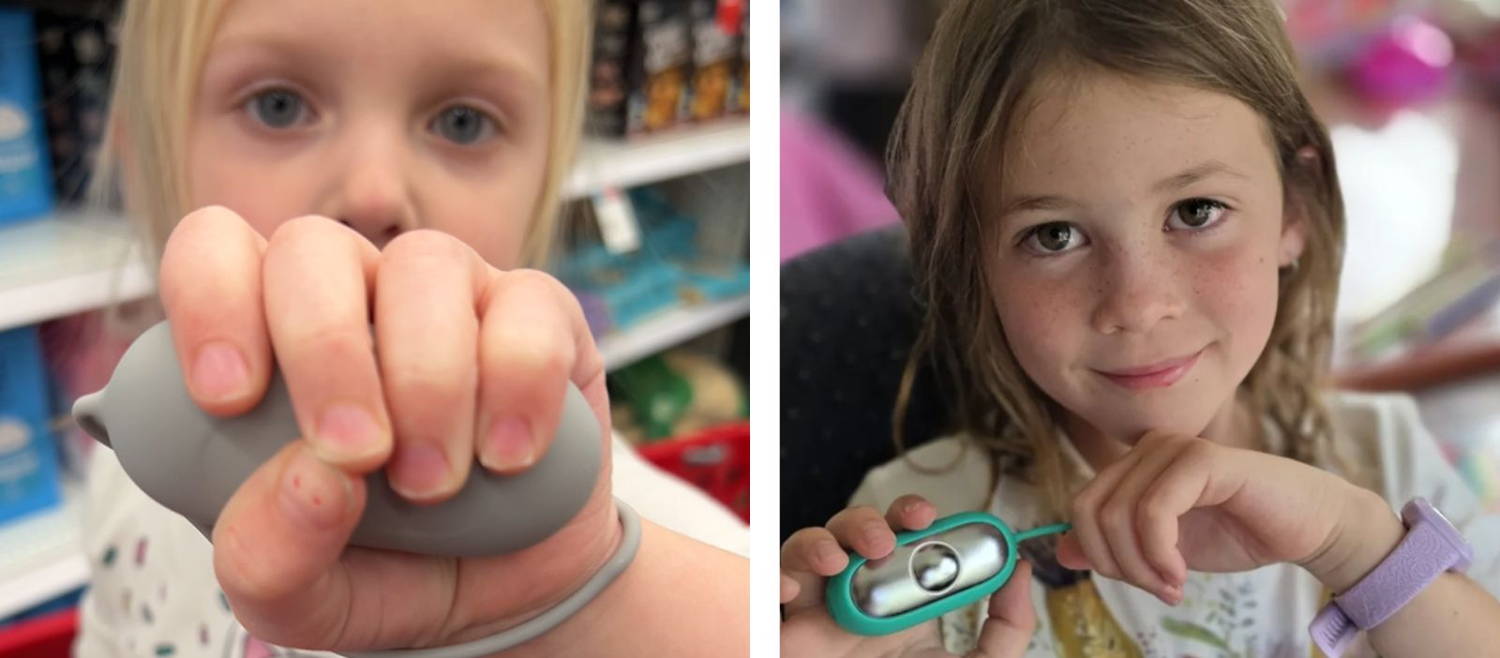
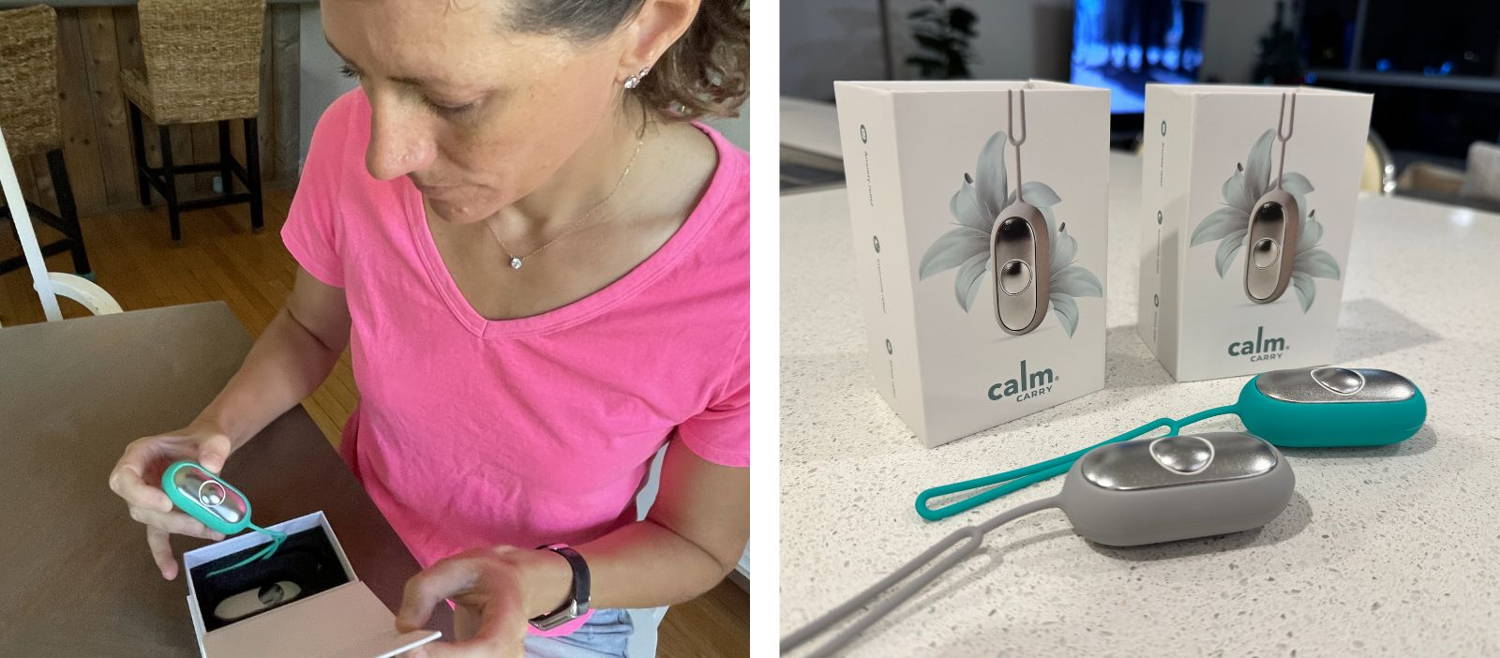
The thing Kate found looks, at first, like a toy. A small grey pebble on a silicone strap, soft on one side, about the size of her daughter’s palm. She almost kept scrolling. A pebble with a heartbeat was not what she expected would end the 9pm negotiations.
Here is what it actually is. CalmCarry is a palm-sized device that sends gentle micro-pulses to the PC8 point in the hand, the spot traditional practice calls the Palace of Peace, used for over 1,000 years to calm the mind. It is not a vibration and not a buzz. It is a soft pulse, a little like a tiny heartbeat in the palm, with four intensity levels so your child always starts gentle and settles on the level that feels right.
And this is what the wind-down looks like, from the doorway.
The moment it is in their hand. It settles into their left palm, the wind-down side, soft side up. Gentle weight, one button. Their hands have somewhere to be, and so does their attention.
The racing starts to slow. The steady pulse gives a busy mind one soft thing to follow instead of the spiral. The calling-out slows. The bids for water get further apart.
The body lets go. You can see it from the doorway: the shoulders drop, the breathing slows, the fidgeting fades. This is the part reassurance was always reaching for and could never quite deliver.
Asleep before it clicks off. Each session runs about twenty minutes and shuts off on its own, so nobody has to creep back in. Most nights, they are asleep long before it ends.
And the quiet part, the part Kate did not expect: because the calm is happening in their hand, it does not walk out the door when you do. Night after night, bedtime slowly stops being something you do to them, and becomes something they can do for themselves.
What the first month usually looks like, honestly.
Night 1. A novelty. Some kids settle the very first night. For most, the first win is smaller: a calmer wind-down, and busy hands that finally have somewhere to be.
Week 1. It earns a place in the routine, right after the story. The wind-down gets shorter. The calling-out spaces out.
By week 4. Most parents tell us this is when it clicks: you are not putting them to sleep anymore. They reach for it themselves.

The Other Parents in the Hallway
“Helps 8yo to calm and focus”
“Bought for my daughter to help her get to sleep faster. She struggles to switch off sometimes, and the Calm Carry has helped her stop her mind from racing at bed time. She loves having something she can grab whenever she wants.”
Kate P., Verified Buyer ★★★★★
“Great product”
“My 10 year old granddaughter... finds it difficult to get to sleep. She has tried other products such as weighted blankets which do help to an extent in bed... The CalmCarry has been so successful in helping her sleep... that she won’t go anywhere without it.”
Pearl W., Verified Buyer ★★★★★
“The Calm Carry does exactly what they claim”
“Starting with the size, it’s perfect for little hands... I like that it has two modes, a faster one for calming and slower one for sleep. Some nights, my kid just needs a little help getting settled and we can use the lowest setting.”
Gloria J., Verified Reviewer ★★★★★
“Desperate for more sleep!”
“I ordered the Calm Carry for my two boys ages 7 and 10 as a last resort to help them get more sleep so that I could get more sleep. I’d been using melatonin when needed... and the effectiveness wore off. I didn’t like the idea of giving them more when I needed it to work.”
Marla L., Verified Buyer ★★★★★


"CalmCarry is what changed things. It sits in your palm and stimulates the PC8 point automatically using gentle micro-pulses. No technique to learn, no app to open, no timing to remember. That consistency is the part that matters more than people realise."
Dr Scott Eilers, PsyD, LP. Licensed clinical psychologist, host of The Depression Doctor podcast. Recommends CalmCarry to his clients.
But Would It Work for Your Child? An Honest Look
A fair question, and the numbers are the most honest way we can answer it:
And if you are weighing it against what is already in the bedtime drawer, here it is side by side:
| Melatonin gummies | Routines, white noise | CalmCarry | |
| What goes into their body | A nightly dose | Nothing | Nothing. It works in the hand |
| Works when you leave the room | While it works. Many parents told us it stopped over time | Only while you stay | Yes. It is theirs |
| Re-buy it every month | Yes | No | No. One-time buy |
| Teaches them to settle themselves | No | Not quite. The calm depends on you | Yes. That is the whole point |
You do not have to take our word for what is happening in the palm. Here is exactly how it works, and the doctors who reviewed it.

The Science Parents Ask Us About (And the Doctors Who Reviewed It)
The question parents ask us most: what is actually behind it? Fair question. Here is how it works.
Gentle micro-pulses. CalmCarry delivers soft, rhythmic micro-pulses you can feel in the palm. Most kids describe it as a gentle tingle, and they control the level themselves.
The PC8 point. The pulses target the PC8 point at the centre of the palm, known in traditional practice as the Palace of Peace and used for over 1,000 years to calm the mind. Modern anatomy shows this exact spot sits over the median and ulnar nerves, two of the main nerves of the hand. Acupressure at points like this is an actively researched area for sleep and calm.
Tactile grounding. A steady physical sensation redirects attention away from racing thoughts, the same principle behind the grounding tools therapists teach.
A ritual, not a chore. Twenty minutes, automatic shut-off, nothing to swallow, nothing to remember at breakfast. Read the full science here.
Reviewed by real doctors. CalmCarry is independently reviewed by licensed physicians through FrontrowMD. Read their assessments below.
Our Promise: The 100-Night Home Trial
Try CalmCarry in your own home, in your own routine, for 100 nights. Make it the last step after the story, use it on the hardest evenings, and let your child be the judge. If it does not earn its place in your family, send it back for a full refund. No questions, no awkward forms. Fewer than 1 in 100 families ever do. That is plenty of bedtimes to know for sure.
Tonight, at 8:20
Kate’s review is up there in the wall above, in her own words. These days the hallway light goes off at 8:20, and the small voice on the stairs has been replaced by something she had almost forgotten: a quiet house, and an evening that belongs to her.
Unlike a bottle of melatonin you re-buy every month, CalmCarry Kids is a one-time buy. No refills, no subscription, no monthly anything. It costs about what a couple of months of gummies cost, once. More than one little night owl? Our family bundles bring the price per child down, built for exactly that. Every discount is applied automatically at checkout. No code needed.
Questions parents ask us
Will it work for my child?
Most parents see the wind-down change within the first week or two, and some kids take to it night one. Every child is different, which is exactly why the 100-Night Home Trial exists. If it is not for them, send it back for a full refund. Fewer than 1 in 100 families do.
What does it actually feel like?
A soft pulse, like a tiny heartbeat in the palm. Not a buzz, not a vibration. Four levels, and you always start on the gentlest.
What age is it for?
CalmCarry Kids is designed for ages 3 and up, with adult supervision recommended for ages 3 to 7. One button, four gentle levels, and an automatic shut-off after 20 minutes.
Is it another thing they will come to depend on?
Nothing goes into their body, so there is nothing to build up or wear off. If anything, the opposite: it gives them a way to practise settling themselves, and that skill stays theirs.
What if it does not work for us?
Send it back within 100 nights for a full refund. No questions, no forms, no awkward phone call.
© 2026 Glowco. All Rights Reserved. Privacy Policy Terms of Use
THIS ARTICLE IS BASED ON REAL CUSTOMER EXPERIENCES WITH CALMCARRY, AND ALL TESTIMONIALS REFLECT THEIR TRUTHFUL FEEDBACK. INDIVIDUAL EXPERIENCES MAY VARY. THE TESTIMONIALS FEATURED ARE FROM ACTUAL CALMCARRY USERS, THOUGH NAMES MAY HAVE BEEN CHANGED TO PROTECT PRIVACY. WE MAY RECEIVE COMPENSATION FOR PURCHASES MADE THROUGH LINKS ON THIS PAGE.