

This article is general information for parents, not medical advice. Nothing here is a treatment for any condition. If your child finds journeys consistently distressing rather than simply boring, or if travelling makes them physically unwell, talk to your GP before you book.
Flying with a child who doesn't travel well is a problem of hours, not of miles. A child strapped into a seat for six hours has nothing to do, nowhere to go and no sense of how much longer it will be, and that is what produces the meltdown two hours from anywhere. The fix is a small bag of ordinary things handed over on a schedule rather than all at once, plus a plan for the four moments that are genuinely hard. Most of what works costs nothing.
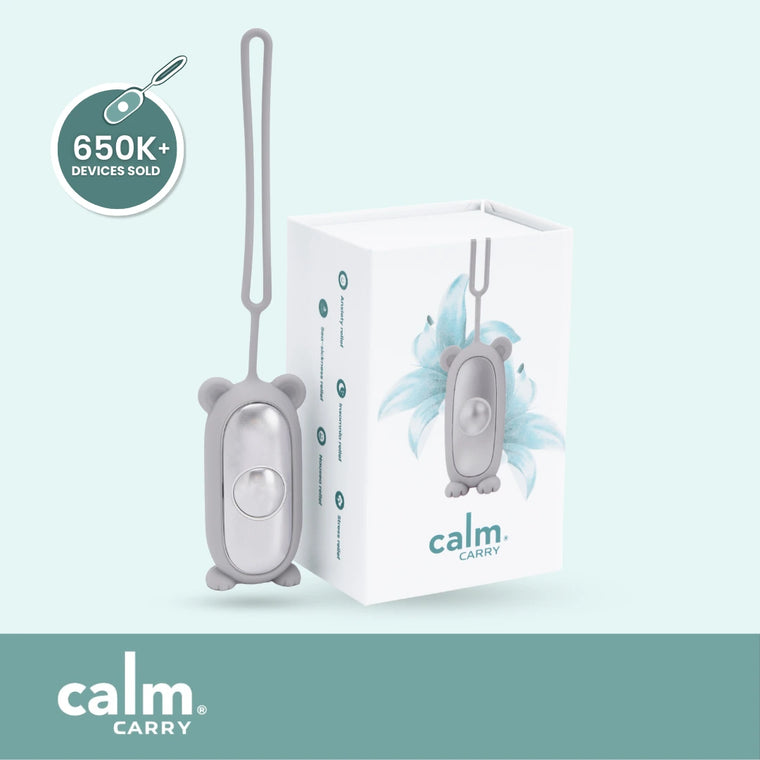
We make CalmCarry, a hand-held calming device for children, and it is one of nine items below. That is declared here rather than buried at the bottom, and the free tactics come first because they do more of the work. This is written by the Glowco team, parents included, who have shipped CalmCarry to more than 650,000 families and hold a rating of 4.9 out of 5 across roughly 1,219 verified reviews. If you are the one who struggles with long journeys rather than your child, we wrote the grown-up version of this list separately.
What to pack for a restless child
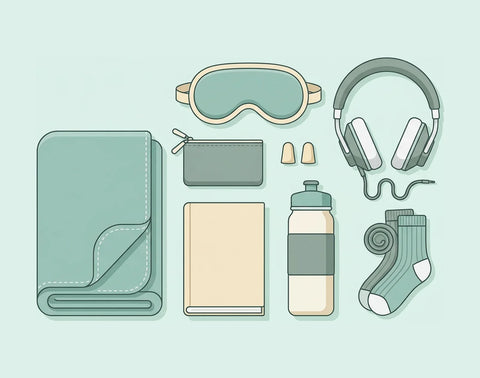
Nine things, in the order they earn their space: their own small bag, one new-to-them thing kept sealed, snacks split into portions, a bottle with a straw, headphones that actually fit, downloaded content, wipes and a spare top, something small to hold, and a jumper that smells like home. Two of those cost nothing.

1. Their own small bag. A child who carries their own bag has a job, a possession and a thing to rummage in. It should be small enough that they can actually carry it down an aisle without hitting three strangers, and they should pack it with you rather than have it packed for them. Half the value is that they know what is in it, so the boredom hour comes with a memory of something to look forward to.
2. One new-to-them thing, kept sealed. The single highest-value item on this list, and it does not have to be new. A charity-shop puzzle book, a toy that has been out of rotation for two months, or a pack of stickers they have not seen will do. The rule is that it stays in the bag, unopened, until you need it. Opening it at the gate wastes it.
3. Snacks split into portions. One big bag of snacks becomes one snack event. Six small bags become six. Split them at home into separate portions, ideally in things they have to open, and hand them over on a schedule rather than on request. Keep one savoury option, because a child three hours into a journey rarely wants another biscuit.
4. A bottle with a straw or a sports lid. Drinking matters more on a plane than most parents expect, because swallowing is what equalises the pressure in a child's ears. Nemours KidsHealth puts it plainly in its guidance on flying and your child's ears: "Drinking a lot is very important. It encourages swallowing, which opens the Eustachian tubes." A straw makes drinking easy at an awkward angle in a seat, and a sports lid survives being dropped.
5. Headphones that actually fit. Adult headphones slide off a small head, and the free airline earbuds fall out. A pair sized for a child, tested at home for at least twenty minutes before you travel, is worth more than any brand claim. Test them on the sofa, not at the gate.
6. Downloaded content, not the seat-back screen. Seat-back systems freeze, in-flight wi-fi is unreliable and a car has no screen at all. Download everything at home, check it plays with the device in flight mode, and pick several short things rather than one long film. A film that ends with three hours left is a problem, not a plan.
7. Wipes and a spare top in a zip bag. Both directions: clean clothes in, wet clothes out. The zip bag is the part people forget and the part that saves the second half of the journey.
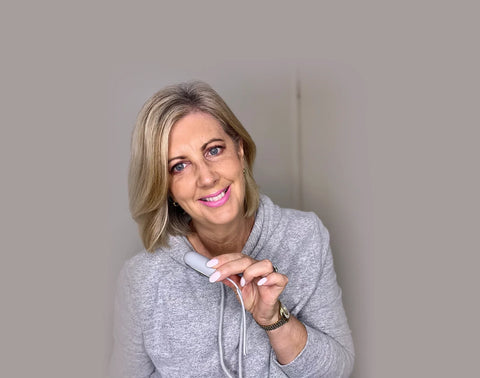
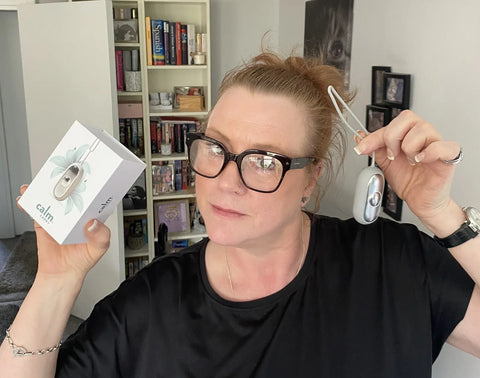
8. Something small to hold. A smooth stone, a fidget, a soft toy small enough to fit in a pocket, or a hand-held device. Ours is CalmCarry Kids, a small bear-eared device a child holds in their palm. It gives a soft pulse, like a tiny heartbeat, against PC8 or Lao Gong, the point at the centre of the palm that acupressure tradition has used for more than a thousand years. It uses a very low microcurrent, felt as a soft pulse rather than a vibration, with eight levels so you can start gently. It is recommended by therapists as part of a calming routine, it is quiet enough not to bother the row in front, and it comes with free accessories, a covers five-pack and our e-book. Plenty of children get exactly the same thing from a soft toy they already own, and if that is your child, keep the money.
9. A jumper that smells like home. Not packed for warmth, although it works for that too. A familiar smell is a cheap and genuinely useful anchor in an unfamiliar seat, and it doubles as a pillow, a blanket and something to hide under when the cabin lights come on.
How to time the bag, not just pack it
Most travel lists stop at what to pack. The part that decides whether a journey goes well is when each thing comes out. Handing over everything at once buys you forty minutes and leaves you with nothing for hour five. Handing things over one at a time turns one long stretch into six short ones.
This is the schedule we use. Adjust the hours to your journey, but keep the shape.
| When | What comes out | Why then |
|---|---|---|
| Boarding and the first half hour | Nothing | Boarding is the entertainment. Let them watch it and save your material. |
| Hour one | Drink, then snack one | Drinking during the climb helps their ears, and a snack marks the start of the journey. |
| Hour two | The new-to-them thing | This is when the first wall arrives. Novelty is the only thing that reliably resets a bored child. |
| Hour three | Screen and headphones | Deploy it once the free options are spent, not before. It is your longest single block. |
| Hour four | Snack two, a walk if you can, something to hold | Movement and a change of texture, in that order. The screen is losing its grip by now. |
| The last hour | Drink, the window, a countdown they can see | Swallowing for the descent, and something concrete to measure the end against. |
Two things make this work. The first is that nothing is given out on demand, so nothing is used up early. The second is that you tell them the plan before you leave the house. A child who knows the new thing arrives after two sleeps of the clock will wait for it. A child who does not know anything is coming will ask for everything now.
Expect roughly half an hour of real attention from anything new, and plan for less with a toddler. That is our rule of thumb from doing this with our own children rather than a measured figure, but it is a more useful planning assumption than hoping one item will cover four hours.
The boredom hour, and what actually fixes it
The hard part of a long journey with a child is not the crying. It is the flat, unfillable stretch in the middle where they have run out of ideas and you have run out of bag. Four free tactics do more for that hour than anything you can buy at the airport.
- Give them the window. A window seat on a plane, or the side of the car with something to look at, gives a child a source of new information that never runs out. On a plane it also means they are not being climbed over every time someone needs the aisle.
- Make the time visible. Children have almost no sense of elapsed time, which is why "are we nearly there" is a real question rather than a provocation. A strip of stickers, one peeled off per hour, or a paper chain with one link torn off at each stage, turns an abstract wait into something they can watch shrinking.
- Talk it through before you go. Walk them through the day in order: the car, the queue, the bag going on the belt, the waiting, the seat, the seatbelt, the long bit, the landing. Novelty is most of what makes a journey hard for a young child, and a rehearsal removes a surprising amount of it.
- Let them be bored early on purpose. The instinct is to entertain from minute one. Resist it. A child who has been mildly bored in the departure lounge will take the first activity far more seriously than one who has already been through three.
None of that costs anything, and between them they usually cover more of the journey than the paid items do. If you want the wider version of this for ordinary days rather than travel, our round-up of calming tools for children covers the same ground at home, and a timed morning routine uses the same trick of giving a child a visible sense of time.

Keeping a child calm on a plane
A flight adds four things a car journey does not: a queue you cannot leave, a seatbelt sign, ear pressure, and an audience. Each has a specific fix, and none of them is a product. Plan for the boarding, the climb, the middle and the descent as four separate problems.
Board late, or split the party. Every extra minute on the plane is a minute of the seat budget spent before you move. If two adults are travelling, send one on early with the bags and keep the child in the open until the end of boarding. If you are on your own, board when called and accept it, because wrestling a bag and a toddler down a full aisle is worse.
Consider a car seat on board. A child who is used to a five-point harness often settles better in one than in a loose adult belt, and the safety case is straightforward. The FAA "strongly urges you to secure your child in an approved CRS or other approved device for the entirety of your flight", noting that turbulence is the leading cause of injury to children on aircraft, and that most young children using one weigh 40 pounds or less. See the FAA guidance on flying with children, and check your airline's rules before you go, because a seat of their own has to be booked.
Have a plan for their ears. Ear pain is the most common reason a settled child suddenly is not one, and it usually arrives on descent rather than take-off. The same KidsHealth guidance suggests keeping them drinking, and for older children chewing gum or sucking hard sweets, which it notes is only for children over three. It also advises staying awake for take-off and landing, "During sleep, we don't swallow as often, so it's harder to keep the air pressure in the middle ear equalized." If your child has a cold or an ear infection, that is worth a call to your GP before you fly rather than after.
Make the bathroom trip early. Go once before the meal service starts and once in the quiet stretch after it. The trolley blocks the aisle for a long time, and a child who needs the toilet while it is out is a bad thirty minutes for everyone.
Stop worrying about the audience. Most people on a plane have either done this or watched someone do it. Managing the row behind you costs attention you need for your own child, and the row behind you is not your problem.
A long car journey with kids: what changes
A car is easier in one way and harder in another. You can stop, which is the single biggest advantage over a plane. But there is no aisle, no crew, no meal service and nothing new to look at once the motorway starts, so the middle stretch drags harder than it does in the air.
Plan the stops before you leave. The UK Highway Code already tells drivers that "a minimum break of at least 15 minutes after every two hours of driving is recommended" in rule 91. Use the driver's break as the child's break rather than treating them as two separate things, and pick stops with somewhere to run rather than the nearest services with a car park and a coffee counter.
Name the next stop out loud. "We stop at the big bridge" is a landmark a child can wait for. "Two more hours" is not. Give them one nameable thing to reach, then the next one.
Be careful with close work in a moving car. Reading, screens and detailed puzzle books make some children queasy in a way they never do on a plane. If that is your child, switch the car legs to audio, audiobooks, music or a talking game, and save the screen for the airport or the hotel. That is not a problem this list can solve with a product.
Layers, not a coat. A coat under a car seat harness is unsafe because it introduces slack that is not there in a crash, and it also makes a child too hot within twenty minutes. Dress them in thin layers and put the blanket over the top of the buckled harness instead.
Pack the front, not the boot. Anything you will want in motion goes in a bag between the front seats, within reach of the adult who is not driving. Anything in the boot is effectively at the destination already.
Travel wristbands are for a different problem
This one is worth spelling out, because the two products get confused constantly and we have been part of the confusion. Travel sickness wristbands press on PC6, sometimes written P6 and also called Neiguan, on the inner forearm a couple of finger-widths above the wrist crease. That is the point associated with nausea. CalmCarry sits over PC8, or Lao Gong, at the centre of the palm. Different point, different tradition, different job.
So if the thing that goes wrong on your journeys is your child's stomach, a wristband is the product built for that and we are not it, and a pharmacist is the right first stop. If what goes wrong is the hours, the boredom and having nothing to do with their hands, that is what a palm device is for. Both are traditional acupressure rather than proven medicine, and it is worth reading what the evidence on acupressure for children actually says before you spend money on either.
One honest safety note on our own product and on anything similar. It has small parts and a cord, so it needs supervision with younger children, it is not something to leave with a child unattended in a car seat or a cot, and you should follow the age guidance on the packaging rather than ours.
What we would leave at home
- A brand-new toy with forty pieces. Every piece will end up under the seat in front, and each one comes with an interruption. New is good, small and self-contained is better.
- One giant bag of snacks. Eaten in the first hour, on principle, because it was there.
- A rigid screen rule you will abandon at hour three. Decide the plan before you leave and be at peace with it. A rule you break under pressure teaches a child that pressure works, which is the opposite of what you want at hour five.
- Anything that needs charging you did not charge. Chargers included. A flat tablet at hour three is worse than never having brought it.
- Travel sickness wristbands bought for boredom. They are a real product for a real problem, and boredom is not that problem.
- Sticker books in a moving car. They are excellent on a plane tray table and hopeless on a lap at 70mph.
Who this guide is not for
- Babies under about a year. The job is completely different and mostly about feeding, changing and sleep timing. Almost none of this applies.
- Children who are physically sick on journeys. This list is built around boredom and being stuck, not nausea. A pharmacist is the right first stop, and the fixes are different ones.
- Journeys under about two hours. A drink, a snack and a window is the whole list. Everything else is weight.
- Children with additional needs who already have a plan. If an occupational therapist or a specialist has given you strategies that work for your child, those beat a general list written for a general reader every time.
- Families where travel is consistently distressing rather than simply hard. Nothing on a packing list is a substitute for talking to your GP, and it is not meant to be.
Questions parents ask about long journeys
What can I do with a restless toddler on a long flight?
Break the flight into hours and give one new thing per hour rather than everything at the start. Keep one item back that they have never seen. Walk the aisle whenever the seatbelt sign is off, and treat the boarding queue and the descent as the two moments where you need something in your pocket rather than in the locker.
How do I keep my child calm on a plane during take-off and landing?
Keep them drinking, because swallowing is what equalises the pressure in their ears, and keep them awake through the descent for the same reason if you can. Have something small and familiar in your pocket for those two stretches, because the bag will be stowed and you will not be able to reach it.
What should I pack for a long car journey with kids?
The same nine items, with two changes. Skip anything that needs close focus if your child gets queasy in a car, and swap it for audio. And pack a proper stop into the plan every two hours rather than treating stopping as a failure.
How long can a child sit in a car seat on a road trip?
Most car seat manufacturers advise regular breaks rather than long unbroken stretches, so check the manual for the seat you own. As a planning rule, the Highway Code's advice to drivers of a break of at least 15 minutes every two hours is a reasonable rhythm for the child too, and it is the one your journey is already built around.
Do travel sickness wristbands help a restless child?
Not for restlessness. They press PC6 on the inner forearm, which is the point associated with nausea. If your child is bored rather than queasy, the wristband is not the product and you would be better off with a snack schedule and something to hold.
Is a hand-held calming device safe for a young child?
Anything with small parts and a cord needs supervision with younger children, should not be left with a child unattended in a car seat or a cot, and should be used within the age guidance on the packaging. Beyond that it is a comfort object rather than a treatment for anything.
Start with the free parts. A window, a visible countdown, snacks handed out on a schedule and one thing they have never seen will get you further into a long journey than anything sold at an airport. If the part your family finds hardest is the flat hour in the middle where there is nothing to do with their hands, CalmCarry Kids was built for exactly that hour. Get it before your next trip, not at the gate.