

This article is general information, not medical advice. A calming device is a comfort tool, not a treatment for any sleep or mental health condition. If sleep trouble has gone on for months, or it is affecting how you cope in the day, that is a conversation to have with your GP.
Do calming devices help you sleep? Partly, and not in the way most product pages imply. There is no good evidence that a hand-held calming device sends you to sleep faster on its own, and any brand telling you otherwise has run ahead of the research. What one can honestly do is give your hands a job and act as a consistent cue inside a wind-down routine, and a predictable routine is the best-evidenced sleep aid there is. We make one of these devices, so this is the version with the caveats left in.
What a calming device actually is
A calming device is a small object you hold that gives your hands something steady to feel, usually through pressure, vibration, a paced light, or a mild electrical current. The category is much broader than the two words suggest. Three quite different products are sold under the same label, and the differences matter more than the marketing does.
| Type | What it does, and what to know |
|---|---|
| Breathing pacers | A light or a rhythm you breathe along with. The active ingredient is the long exhale, which you can do for free, so you are paying for the prompt rather than the effect. |
| Microcurrent devices | Pass a small electrical current through the skin. This is a regulated category in several countries, with its own rules, its own research and its own cautions. Read the manufacturer's guidance closely. This is the group CalmCarry belongs to. |
| Pressure and vibration tools | Rest against a point on the hand and give a soft, repeating press or vibration. Nothing is ingested, nothing pierces the skin and no current is involved. |

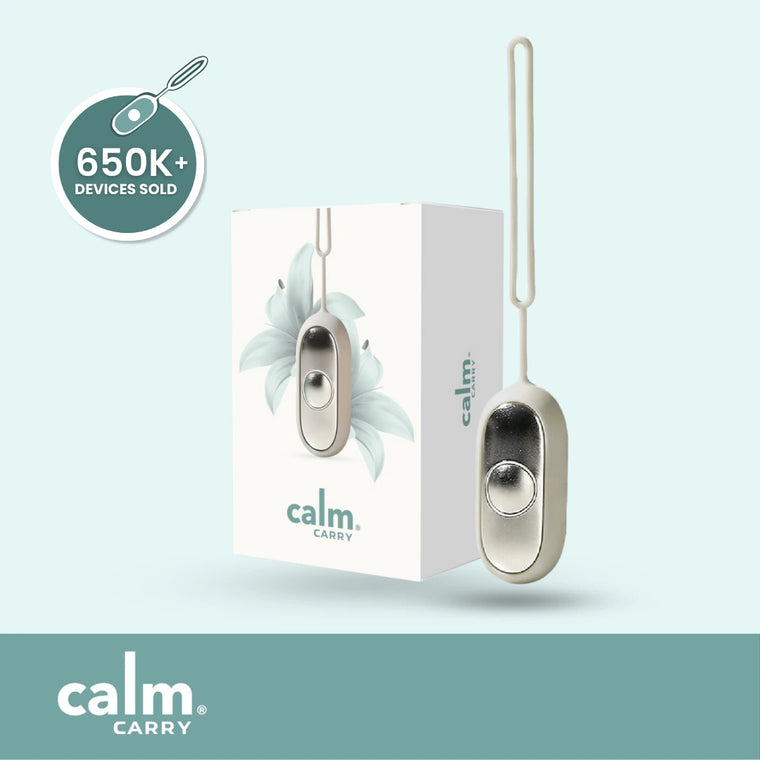
Ours, the CalmCarry hand-held calming device, sits in the second row. It gives a soft pulse, like a tiny heartbeat, against PC8, also called Lao Gong, the centre of the palm, a point used in acupressure tradition for over a thousand years. It uses a very low microcurrent, felt as a gentle pulse or tingle rather than a vibration. That is worth stating plainly, because these categories are confused constantly, including by people writing about them. One more thing gets mixed up: PC6, or Neiguan, is a different point on the inner forearm, and it is the one associated with travel sickness rather than sleep. Our explainer on the PC8 point covers where the tradition comes from.
What the sleep evidence says, and does not
Thin, and thinner the closer you get to sleep specifically. There is a real body of research on the acupuncture and acupressure family, but it sits over pain and nausea, not over falling asleep. For consumer hand-held calming devices, there is no meaningful set of trials measuring how long people take to fall asleep or how often they wake.
Where there is genuine research. The US National Center for Complementary and Integrative Health summarises the evidence for the acupuncture family across back and neck pain, knee osteoarthritis, migraine, allergic rhinitis and treatment-related nausea. Read that list again and notice what is not on it. Sleep is not there. We are pointing at our own tradition's evidence page and telling you it does not cover the thing this article is about.
Where it thins out. Studies on this kind of device are hard to run well, because you cannot easily blind someone to whether something is pulsing in their hand. Such research as exists tends to be small and set in specific clinical groups rather than in ordinary adults having a wound-up week. That is not proof that nothing happens. It is an absence of proof that something does, and those are different claims.
What would change our mind. A reasonably sized randomised trial in ordinary adults, with a credible dummy device, measuring time to fall asleep and night waking over several weeks. Nobody in this category has published that, ourselves included. Until somebody does, treat every calming device on the market, ours among them, as a comfort tool rather than a sleep aid.
Why a device can still help at bedtime
Because the useful part is not the device, it is the repetition. A wound-up adult at bedtime is looking for somewhere to put their attention and their hands. A small object that gives steady, repetitive feedback does two jobs: it occupies the hands, and it becomes a cue, the same object at the same moment every night.
That is the honest mechanism, and it has nothing to do with treating anything. It is the same reason a hot shower, a familiar book or the same low playlist works. None of them are treatments. All of them make a routine easier to run.
The evidence for the routine is far stronger than the evidence for any gadget. For long-running insomnia, the American College of Physicians recommends cognitive behavioural therapy for insomnia as the first treatment adults should be offered, ahead of medication. A large part of what that therapy does is impose consistency on the hours around sleep. Holding the same object at the same point every night is a very modest, over-the-counter cousin of the same idea, and it should be described that way rather than dressed up.
Where a device fits in a wind-down hour
Last, and small. The hour before bed does the work, and the device is a cue inside it rather than the point of it. The NHS advice on insomnia is to relax for at least an hour before bed, keep the bedroom dark and quiet, get up at the same time daily, and stay off screens right before sleep. A hand tool changes none of that. It slots into the last ten minutes of it.
- 60 minutes out. Last screen, or dim everything if that is unrealistic. Lights down in the room you are actually in.
- 40 minutes out. The boring admin: bag packed, tomorrow's list written down. Anything you leave undone here your brain will do for you at 1am.
- 20 minutes out. The same thing every night. A shower, a chapter, a stretch. Sameness is the feature, not a lack of imagination.
- 10 minutes out. Hands and breathing. Long exhales, and a calming device before bed if you use one. Same object, same hand, same order.
Adults build careful bedtime routines for their children and give themselves none. If you want the version without any device in it at all, there are nine things to do with your hands that cost nothing and need no object.
Who a calming device is not for
- Anyone hoping it replaces treatment. Months of bad sleep, low mood, or exhaustion that survives a full night in bed belongs with your GP, not in a shopping basket.
- Anyone with a likely medical cause. Heavy snoring, waking with a start, or daytime sleepiness that does not lift can point to sleep apnoea. No hand-held object touches that.
- Anyone whose evenings are the actual problem. Late caffeine, a 10pm inbox and wall-to-wall screens will beat any tool you can hold. Fix the hour first and the tool does more.
- People who dislike any tingling. Some find a pulse in the palm irritating rather than settling, even on the lowest level. If that is you, a smooth stone or a worry ring does the same job silently.
- Anyone who wants a number. A calming device measures nothing and reports nothing. If you want data on your sleep, this is the wrong purchase.
How we talk about our own device

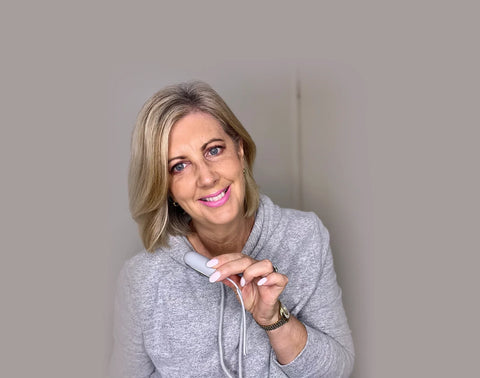
CalmCarry Find Your Peace is the adult version. It gives a soft pulse, like a tiny heartbeat, against the PC8 point in the centre of the palm. We describe it as a comfort tool that fits into a wind-down routine, because that is what the evidence supports us saying. It is recommended by therapists, over 650,000 families keep one, and people rate the brand 4.9 out of 5. What we will not tell you is that it treats a sleep condition, or that it is clinically proven, or that it will do much on a night when you go to bed at 1am with your phone.
If you would rather see it next to everything else first, our round-up of the best calming tools for adults puts devices alongside free options like long-exhale breathing and getting outside, several of which cost nothing at all.
Common questions
Do calming devices work?
They work as anchors. Something to hold and focus on while a moment passes is a real and useful effect, and it is a different claim from treating anything. Expect a device to make a routine easier to keep, not to fix stress or sleep on its own.
Will a calming device help me fall asleep faster?
There is no good research showing it will. If it helps, the likely reason is that it marks the end of your day consistently, and consistency is what the sleep evidence actually supports. Judge it over a fortnight of the same routine, not on one night.
Is a calming device the same as a microcurrent device?
Not every calming device is. Microcurrent devices pass a very small electrical current through the skin, felt as a pulse or tingle, and come with their own guidance on who should not use them. CalmCarry is a microcurrent device, which is why we recommend starting on the lowest level and list who should not use it on the product page. It is worth checking which kind you are looking at before you buy.
Can I use one in the middle of the night?
Yes, and keep everything else boring while you do. Long exhales, low light, no phone. If waking at night is a settled pattern rather than an occasional bad week, raise it with your GP rather than adding another gadget.
Do these devices work for children?
The same honest answer applies, with a smaller evidence base again. We wrote it up separately in our honest look at acupressure for kids.
Is it worth taking one travelling?
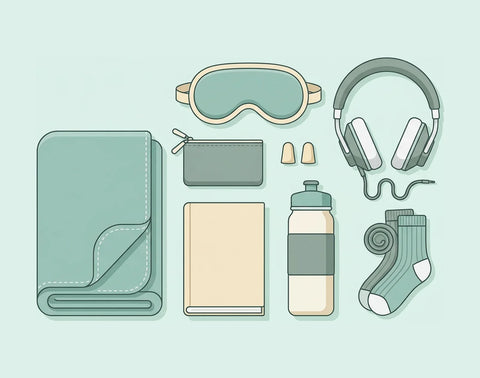
This is where a hand tool earns its place most easily, because a long journey is a stretch of time with nothing to do and nowhere to go. Our list of what to pack for a long flight covers the rest of it.