

This article is general information, not medical advice. Nothing here is a treatment for any medical condition. If restless hands, or the feelings behind them, are persistent or getting in the way of your daily life, please speak to your GP.
The best things to do with your hands when you feel wound up are the ones that give them a defined job with a rhythm and an end point. Press your thumb into the centre of your palm for a slow count of five, then release for five. Count down your fingertips, one breath per finger. Trace the outline of a key with one fingertip, then trace it backwards. All three are free, none of them needs anyone else to notice, and every one of them works with your hands in your lap.
Search for things to do with your hands when you are anxious, or what to do with your hands when nervous, and most of what comes back is a shopping list of objects. Objects can help, and one of them is ours, but they are not the point and they are always in the other coat when you need them. We make a hand-held calming device for adults, so the free techniques come first here and take up most of the article. Ours appears once, at number eight.
Why giving your hands a job helps
Restless hands are looking for input. A defined task closes the loop: a set count, a texture to follow, a rhythm that is not yours to invent. Rather than deciding what to do next every few seconds, you follow something. That is the whole mechanism, and it is worth saying plainly that the research on adult fidgeting is thin and mixed rather than settled.
Keeping your hands busy when you are stressed is not the same as keeping them moving, and the difference is where most advice on this goes wrong. So treat everything below as something to test on yourself. Two things separate the techniques that stick from the ones that do not. First, a count or a rhythm beats free-form fiddling, because free-form fiddling is just another decision. Second, if your default when you are keyed up is picking at nails, cuticles or skin, a technique that occupies those same fingers is far more realistic than telling yourself to stop.
None of this is only for a stressful meeting. The same techniques work in a waiting room, in the ten minutes before a difficult call, on a plane, or at 11pm when you have gone to bed and your hands have not. If evenings are your problem more than meetings, our round-up of calming tools for adults covers the objects side in more depth.
9 things to do with your hands
Ordered roughly from the most discreet to the most obvious. Numbers one to seven and number nine cost nothing at all. Number eight is the thing we make, and it sits at eight because it does one thing the others do not, not because it deserves the top of a list.
1. Press the centre of your palm with your thumb
Make a loose fist with your left hand and notice where the tip of your middle finger lands. That hollow, roughly in the centre of the palm, is the spot. Open your hand, put the pad of your right thumb on it, and press firmly enough to feel clear pressure but not pain. Hold for a slow count of five, release for five, and repeat ten times before swapping hands.
That spot is called Lao Gong, or PC8, and it has been used in acupressure tradition for over a thousand years. We are not claiming it treats anything. It is simply easy to find, easy to press hard enough to feel, and completely invisible under a table. If you want the background, we have written separately about the point in the centre of the palm.
2. Count down your fingertips, then back up
Touch your thumb to your index finger, then to the middle, ring and little finger, then reverse the order. One slow breath per touch. Do it on both hands at once if you can, which is harder than it sounds and therefore more absorbing.
The value is in the counting, not the touching. If you lose your place, start again. Losing your place and starting again is the technique working, not failing.
3. Trace an edge, then trace it backwards
Pick up something with a defined outline: a key, a coin, a ring, a phone case, the seam down your trouser leg. Follow the whole outline with one fingertip, slowly, feeling every corner. When you get back to where you started, go round the other way.
The reversal is the part that matters. Going the familiar way becomes automatic within a lap or two, and automatic is exactly what you do not want. Changing direction pulls your attention back every time.
4. Squeeze for five, release for ten
Make a fist at roughly seven tenths of your full strength. Hold it for a count of five. Then open your hand completely and let it lie open and heavy for a count of ten. Eight rounds is enough.
The release is deliberately twice as long as the squeeze, because the release is the useful half and it is the half everybody rushes. No stress ball is needed, though one makes it easier to keep the pressure even.
5. Write it out by hand
Longhand, on paper, slowly enough to stay legible. A list, the next three things you have to do, or the sentence you are dreading saying. The speed limit of handwriting is the point: your hand cannot go much faster than twenty words a minute, and the rest of you tends to follow it down.
In a meeting this is the best-disguised option on the list, because it looks exactly like taking notes.
6. Cool water over your hands and wrists
Twenty to thirty seconds of cool, not cold, water over the palms, the backs of the hands and the inside of the wrists. Then dry them slowly, finger by finger, rather than in one quick rub.
This one needs a sink, so it is a leave-the-room technique. It is also the reason so many people disappear to the loo five minutes before they have to present.
7. Give your hands a task with a clear finish
Fold one load of laundry. Peel a satsuma in a single piece. Wash the pans. Water the plants. Shuffle a deck and deal four hands to nobody. The rule is that the job must have a visible end, because an open-ended job leaves the loop open.
This is a home technique, and it is the most reliable one on the list whenever you are somewhere you can use it.
8. Hold something that keeps its own rhythm
Every technique above asks you to supply the rhythm. Some evenings you do not have one to supply, and that is the point at which an object carrying its own rhythm is genuinely different from a fidget toy you have to drive yourself.

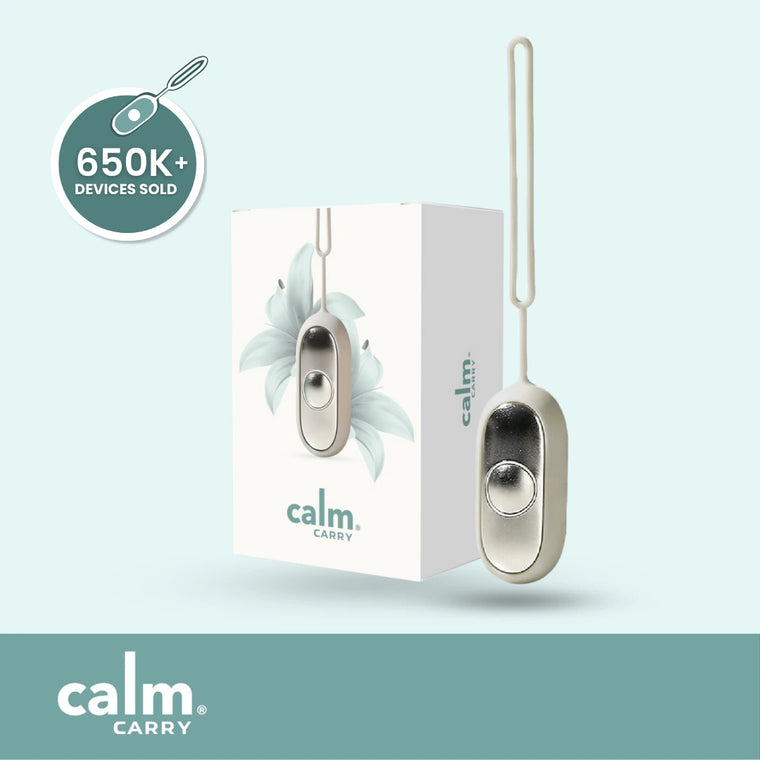
That is what we make. CalmCarry is a small hand-held device that sits in the palm and gives a soft pulse, like a tiny heartbeat, against PC8, the point in the centre of the palm from technique one. It uses a very low microcurrent, felt as a soft pulse rather than a vibration, and it is made to be held rather than watched. It is used by 650,000+ families, rated 4.9 out of 5, and it is recommended by therapists. It also comes with free accessories, a covers 5-pack and the CalmCarry e-book.
The honest limits: it costs money and the other eight do not, and it only helps if it is on you. Keep it in the bag you actually carry rather than the drawer you mean to open.
9. Put your palms flat and do nothing, on purpose
Both palms flat on your thighs or on the table, fingers spread slightly, and hold still. Count the seconds. Most people get to about twenty before something in the hands wants to move, and noticing that wanting is more useful than any of the eight techniques above it.
It is also the only one that still works when there is nothing to hold and nowhere sensible to put your hands, which is most of the moments people are actually asking about.
Where each one works, and where it does not
Discretion decides which technique you will actually use, and half of these are useless in the room you are currently in. This is the part nobody publishes, so here it is in full. The ratings below are about how visible each one is to other people, not about how well it works in a quiet room on your own.

- In a meeting, at a table. Techniques 1, 2, 3 and 9 with your hands in your lap. Technique 5 in plain sight, because it reads as note-taking. Technique 4 is borderline, since a clenched fist shows even under a table.
- On a video call with your hands in shot. Drop your hands below the desk line and use 1, 2 or 9. Anything with repeated motion reads as fidgeting on camera, which lands worse than doing nothing at all.
- In a queue or a waiting room. Almost everything passes unnoticed here, because nobody is looking. 1, 2, 3, 4, 8 and 9 all work.
- In a car, or in a plane seat. As a passenger, any of them. As the driver, none of them, because both hands stay on the wheel. On a long flight these are the techniques that need no luggage at all, and they sit alongside the physical kit in our guide to long haul flight essentials.
- Standing up to speak. Technique 4 with your hands behind your back before you start, then let them hang. Do not take an object up there with you.
- At home, before or after the thing. Techniques 6 and 7 come into their own, and both beat anything you can do sitting at a table.
If you are choosing for one specific recurring moment, pick a single technique for that moment and rehearse it twice while nothing is wrong. A technique you have only ever read about will not be there when you need it.
What this will not do
- It will not treat a medical condition, and it is not a substitute for advice from your GP.
- It will not stop the thought that set it off. Hands settle first. Thinking may follow and may not, and expecting otherwise is how people decide these things do not work.
- It will not work the first time under pressure if the first time is under pressure. Every one of these is easy in a calm room and awkward in the moment, so practise each one twice while nothing is wrong.
- It will not help if your hands are restless most days rather than in specific moments, or if you are damaging skin or nails. That is a conversation with your GP, not a technique.
- Objects get lost, run flat, and live in the other coat. That is exactly why the free techniques come first.
Questions about restless hands
What can I do with my hands when I am nervous in a meeting? Keep them in your lap and press your thumb into the centre of the opposite palm for a count of five, then release for five. Counting down your fingertips works just as well and is equally invisible above the table. If you need to look occupied rather than still, write by hand instead.
Why do my hands get restless when I am stressed? Most people describe it as needing to move rather than choosing to. Whatever sits behind it, the practical answer is the same: hands settle faster when they are given something specific and countable to do than when you simply tell them to stop.
Do fidget toys actually work for adults? Some people find them useful and some find them one more thing to lose, and the evidence is thin either way. The distinction worth making is between an object you have to drive, which is one more decision, and one that keeps a rhythm you can follow. Test the free techniques first, since they cost nothing to try. If bedtime is what you are really asking about, we have gone through whether calming devices help you sleep and where the evidence runs out.
What is the point in the middle of the palm called? Lao Gong, also written PC8. It sits roughly where your middle fingertip lands when you close a loose fist, and it has been used in acupressure tradition for over a thousand years. It is not a clinical treatment, and we have looked at what the evidence on acupressure does and does not show.
Is it bad to pick at my nails when I feel keyed up? If it is breaking skin or causing damage, speak to your GP. Short of that, swapping tends to work better than stopping: give those same fingers a defined job, such as tracing an edge or counting down fingertips, so there is somewhere else for them to go.
What can my child do with their hands? Techniques two, three and nine transfer well to children, usually with a shorter count. We have a separate list of calm-down tools for children, and the same ideas run through a calmer school morning routine.
Pick one technique rather than nine. The one you will actually use is the one that suits the room you are usually in when your hands get restless, so start from the table above rather than from the list. And if you would like something that keeps a rhythm for you on the evenings you have none to spare, this is the one we make.