

This article is general information for parents, not medical advice. Nothing here is a treatment for any condition. If mornings are consistently distressing for your child rather than simply slow, talk to your GP or paediatrician.
The fastest way to make school mornings calmer is to take work out of the morning and run what is left backwards from the time you actually leave. Set clothes, bags and breakfast choices out the night before, wake your child about 40 minutes before you go, and protect the last five minutes as slack rather than sprint time. Nobody has to get up earlier. What changes is the number of decisions a half-awake child has to make before eight o'clock.
We make a calm-down device for children, so the free parts of this come first and take up most of the article. A rushed morning is a scheduling problem before it is anything else, and no object fixes a schedule.
What actually makes school mornings calmer
Four things do nearly all the work: fewer decisions, the same order every day, a wake-up that is light and quiet instead of a countdown, and five minutes of deliberate slack at the end. Speed is not on the list. Households with calm mornings are rarely faster. They are more predictable, and predictability is the only thing a sleepy child can follow.
- Fewer decisions. Every choice offered at 7am is a place the morning can stall. Which shirt, which cereal, which shoes. Decide the night before and the morning has nothing to argue with.
- The same order every day. Not the same times, the same sequence. A child who knows breakfast always follows the bathroom stops needing to be told.
- A quiet wake-up. Open the curtains, turn on a lamp, say one sentence and leave. Repeated calls from another room teach a child that the first four do not count.
- Slack at the end. If your routine is built to finish at exactly the moment you leave, every small delay lands on the front door. Build it to finish five minutes early.
The 40-minute school morning, step by step
Pick the time you genuinely walk out of the door, not the time you wish you did, and count backwards. Forty minutes suits most primary-aged children who are not showering. Slower starters need 50 to 55. The numbers matter far less than keeping the same order every single day, weekends included where you can.

40 minutes out: wake. Curtains open, lamp on, one gentle call, then leave the room. Light does more to wake a child than volume does.
35 minutes out: five quiet minutes. No instructions, no list, no getting dressed. This is the single most skipped step and the one that prevents the most tears. A child pulled straight from sleep into demands starts the day already behind.
30 minutes out: breakfast. Same seat, same two options, clock in view. Fifteen minutes is plenty. If your child is a slow eater, that is a reason to wake earlier, not a reason to hurry them.
15 minutes out: dressed, teeth, bag. Clothes are already out. The bag was packed last night and is by the door. This block should be dull.
5 minutes out: shoes on, then wait. Shoes and coat on with time to spare, then five minutes of nothing. Reading, a window, a chat. Those five minutes are what stop the door becoming the flashpoint.
How do I find where our mornings actually break?
Run a three-morning audit before you change anything. On three ordinary school days, write down four clock times and nothing else: when your child's feet hit the floor, when they sit down to eat, when they are fully dressed with shoes on, and when you actually leave. Four numbers, three days, no judgement.
Then subtract. The gap that is both the longest and the most variable across the three days is your real problem, and in most households it is not the gap parents assume. Here is how to read it.
- A long gap between waking and eating. The wake-up is the bottleneck, not your child. Start with light, a longer quiet five, and one call instead of five.
- A long gap between eating and being dressed. Dressing is the flashpoint. Move the clothes decision to the night before and cut the choice to one outfit.
- A short but wildly variable last stretch. Things are being looked for. That is a storage problem, not a behaviour problem. One named hook, one named shelf, everything on it before bed.
- Every gap reasonable, but you still leave late. The whole routine starts too late. Move the wake time back in 10-minute steps until the last five minutes are empty.
Three mornings of writing down four numbers is a smaller job than a new reward chart, and it tells you which fix to bother with. Most advice on this topic hands you a generic routine. Your own four numbers will beat it.
What can we move to the night before?
Almost everything that involves a decision or a search. The night-before list is the highest-leverage free change available, and it only works if it stays short. Four items done every night beat eleven done twice.
- Clothes out, socks and shoes included. Socks and shoes are where morning searches actually happen.
- Bag packed and by the door. Homework in, water bottle filled, permission slips signed and inside.
- Breakfast narrowed to two options. Both fine, both fast, decided the night before if your child likes to know.
- A five-minute tidy of one surface. The shelf or hook where the bag, shoes and coat live. Nothing else.
Do these with your child rather than for them. A seven year old who packed their own bag knows where the reading folder is at 7.40am. A seven year old whose parent packed it does not.
What if my child will not get dressed?
Pick one position for dressing, before breakfast or after, and never move it again. Lay out one outfit rather than a choice, or two if your child needs some say, and make sure both are fine by you. Dress in a warm room. If resistance happens at the same point every single day, treat that as information about the routine, not defiance.
Three things that reliably help. Get the room warm, because cold is a real and under-rated reason children stall at dressing. Put the clothes in the order they go on, so nobody has to think. And give the instruction once, in the room, rather than shouted from the kitchen, then let the sequence carry it.
If your child stalls because they are wound up rather than uninterested, the fix is a two-minute pause, not more pressure. Our round-up of calming tools for kids covers the free versions of that pause, including breathing games and a five-item calm box, several of which cost nothing. The same trick of making time visible, so a child can see how much is left rather than being told, is what holds a long journey together too, and we set it out hour by hour in our guide to flying with a child who doesn't travel well.
Does an earlier bedtime fix the morning?
Partly, and it is worth doing, but a consistent wake time does more. The American Academy of Pediatrics endorses 9 to 12 hours of sleep for children aged 6 to 12, and short sleep is common: CDC survey data put the share of US children not getting enough at between a quarter and a half, depending on the state. A child who is genuinely short on sleep will fight every step above.
The practical version: move bedtime earlier by 15 minutes at a time, a week apart, and hold the wake time steady, including at weekends where family life allows. Shifting bedtime an hour in one go usually produces a child lying awake in the dark, which helps nobody. If bedtime itself is the battle, we count the last hour backwards in exactly the same way in our routine for settling a child at bedtime, and our guide to melatonin-free ways to wind down covers the supplement side of it. If your child sleeps long enough but still surfaces slowly, waking up groggy is a separate problem with separate fixes.
Where a calm-down tool fits in a school morning
It fits in one narrow place: the two minutes after something has already gone wrong. A hand-held object gives a wound-up child somewhere to put their hands and a reason to stop moving, which is often enough to restart the sequence. It will not buy back ten lost minutes, and any brand suggesting otherwise is overreaching.

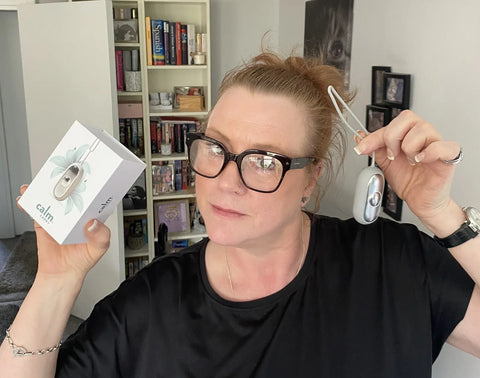
The CalmCarry Kids Mini Bear is a small bear-eared device that sits in the palm and gives a soft pulse, like a tiny heartbeat, against the PC8 point, also called Lao Gong, in the centre of the palm. That point has been used in acupressure tradition for over a thousand years, which is how we describe it and as far as we will go. It is recommended by therapists, more than 650,000 families keep one, and families rate us 4.9 out of 5. For the honest version of what the research does and does not show, read what the evidence on acupressure says. If you want to try the point with just your thumb before buying anything, our guide to finding the PC8 point walks through it.
Used in a morning, it works best as a fixed part of the quiet five rather than something produced in the middle of an argument. Same moment, same place, every day, like everything else here.
Who this routine is not for
- Households where the leave time genuinely changes daily. Counting backwards needs a fixed end point. Anchor to the earliest one you have and accept slack on other days.
- Children under about four. A five-step sequence is too much. Two steps and a lot of help is the realistic version.
- Mornings that follow a short night. Fix the sleep first. No routine survives a genuinely tired child.
- Shift-work and split-week households. The order still helps, the fixed times will not hold, and pretending otherwise sets everyone up to fail.
- A child who is distressed most mornings rather than slow. That is worth a conversation with your GP or your child's teacher, not another routine tweak.
School morning questions parents ask
How long should a school morning routine be?
About 40 minutes from waking to leaving for most primary-aged children, or 50 to 55 for slower starters or anyone showering. Longer than 60 minutes usually means the morning has picked up jobs that belong to the night before.
What time should my child wake up for school?
Count backwards from the time you actually leave, not from the school bell. If you leave at 8.20am and your child needs 40 minutes, that is a 7.40am wake, and bedtime then has to be early enough to give them 9 to 12 hours.
Should getting dressed come before or after breakfast?
Either works. What matters is picking one and never swapping. Before breakfast suits children who dawdle over food; after suits children who need to eat before they can cooperate with anything.
Do reward charts help with school mornings?
Sometimes, briefly. They tend to fade because they add a step rather than removing one. Run the three-morning audit and the night-before list first, since both take work out of the morning instead of adding a new thing to remember.
How long before a new morning routine feels normal?
Give it two full school weeks and expect the first three days to be worse, because you are changing a habit that currently runs on autopilot. Change one block at a time rather than the whole morning at once.
If the person who most needs the calmer morning is you rather than your child, our round-up of calming tools for adults covers the grown-up half of the house.
Start tonight rather than tomorrow morning. Clothes out, bag by the door, two breakfast options agreed, then run the audit for three days before you change anything else. If you would also like something for your child to hold during the quiet five, this is the one we make.