

This article is general information for parents, not medical advice. Nothing here is a treatment for any condition. If your child is regularly distressed at bedtime rather than simply unsettled, talk to your GP or paediatrician.
Helping a child settle at bedtime comes down to making the last hour predictable and slightly boring, in the same order, every night. Dim the lights an hour before sleep, get screens out of the bedroom, move into the bedroom for the final twenty minutes, and give your child one thing to hold once the lamp goes off. The order matters more than the times. A sequence is something a tired child can follow when instructions are not.
We make a hand-held calming device for children, so the free parts of this come first and take up most of the article. Further down sits a first-hand account from Jodie K., a customer who wrote to us about her son Ethan. It is kept in her words and edited only for length.
Why won't my child settle at bedtime?
Most bedtime resistance is not defiance. It is a child whose body is still switched on meeting a room that has just gone quiet and dark, with nothing left to occupy them but their own thoughts. The hour before lights-out is where that gets decided, which is why changing what happens beforehand works better than anything you try afterwards.
Four things reliably keep a child switched on past their bedtime, and all four are things you control.
- Bright light too late. Overhead lights and screens both tell a body it is still daytime. Lamps beat ceiling lights for the last hour.
- Something exciting too close to bed. Rough-and-tumble, a gripping episode, a difficult conversation. Anything that raises the temperature inside the last half hour gets paid for in the dark.
- A different order every night. Bath before story on Monday, story before bath on Tuesday. A child who cannot predict what comes next has to stay alert to find out.
- Nothing to do with their hands. Lying still in the dark is a skill. Younger children have not built it yet, and a child with nothing to hold will find something, usually you.
The 6-step wind-down that settles bedtime
Count backwards from lights-out rather than forwards from dinner. Sixty minutes suits most children from about four upwards. Run the same six steps in the same order, and let the clock be approximate. Consistency of sequence is doing the work here, not precision of timing.

60 minutes out: take the house down a level. Overhead lights off, lamps on, television off or volume down, and no new activities started. You are not asking anyone to be quiet. You are removing the things that keep a body busy.
45 minutes out: screens off and out of the bedroom. Off, not paused, and charging somewhere other than the bedroom. A tablet in the room is a negotiation waiting to happen at 9pm. This single step does more than most of the others combined.
35 minutes out: bath or wash, then straight into pyjamas. The warm-then-cool of a bath is a useful cue, and the practical value is bigger: it marks a clean line between the day and the evening that even a small child can feel.
20 minutes out: into the bedroom and stay there. Teeth, curtains, water, toilet, all done now. Every trip back out after this point is a re-start. Get the whole list finished before you sit down.
10 minutes out: story, same chair, same lamp. One or two books, agreed in advance so the choosing is not itself an event. If your child likes to talk, this is the slot for it. Questions asked in the story chair rarely reappear after lights-out.
Lights out: one thing to hold, one sentence, then leave. A soft toy, a pillow-sized comforter, a hand-held device, whatever your child actually reaches for. Say the same short line every night, then go. The line matters because you will be repeating it in ten minutes.
If bedtime is not where your day breaks, the same backwards-counting trick works at the other end. Our timed routine for calmer school mornings moves most of the morning's work to the night before.
What to do when they call you back
Answer the first call properly and briefly, then answer every call after it with the same short sentence and no new information. The pattern is what settles it, not the content. Children keep calling when each return produces something different: a longer chat, a drink, a negotiation, an argument. Sameness is boring, and boring is what ends it.

What that looks like in practice. Go in the first time, deal with the real thing if there is one, and leave inside a minute. From then on, stand in the doorway rather than sitting on the bed, say your one line, and go. Pick a line you can say flatly at the twelfth time of asking, something like "it's sleep time now, I'm just here." Do not start a new conversation, do not bring anything into the room, and do not answer from the kitchen, because a shouted reply is a reward too.
Two extra notes worth having. If the call-backs are always about worries, move that conversation into the story slot, before the lights go off, where you have the time to do it properly. And if you have promised to check back, actually check back, early and briefly, before you are called. A child who knows you are returning stops having to summon you.
A parent's account of what changed at bedtime
Jodie K. wrote to us about her son Ethan. We have kept her account in her own words and edited only for length. Her experience is hers, not a promise about anyone else's child.
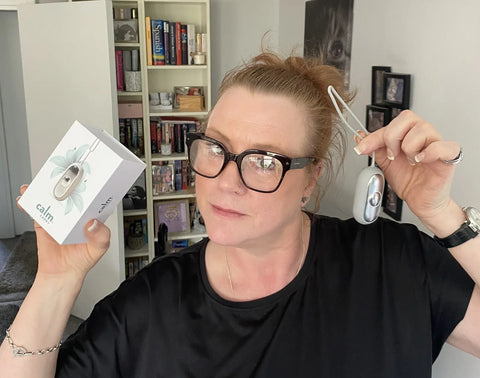
"As a mom, there's nothing more difficult than watching your child struggle, especially when it's something as important as sleep. My son, Ethan, has always been a bright and active boy, but when bedtime rolled around, it was a completely different story. I would tuck him in, read him his favorite story, and turn off the lights, hoping tonight would be different. As soon as the room darkened he would toss and turn, and I could see how wound up he was."
"We tried a lot of things: soothing music, calming teas, even a weighted blanket. Some helped a little. None of them changed the pattern, and I began to dread bedtime as much as he did."

"I was skeptical about CalmCarry. Could a small device really make that much difference? The first night, Ethan held it in his hand and I watched his breathing slow down. He settled faster than he had in months, and he fell asleep without a struggle."
"It has been part of our bedtime ever since. He asks for it, which is the part I did not expect. Bedtime stopped being a fight, and after two years of it being the hardest half hour of the day, that is what I would tell another parent."
Jodie K., CalmCarry Kids customer
We keep this story on the blog because it is the honest version: a routine that was already in place, plus one object the child took to. Plenty of families settle bedtime on the routine alone, and some children never take to a device at all.
Where a calming device fits in this routine
It fits in exactly one place: step six, the thing your child holds once the lamp is off. Its job is to give a body something to do in the dark so the mind has less room to run. It is not a sleep aid, it does not treat anything, and it will not rescue a bedtime that starts at nine o'clock with the television on.

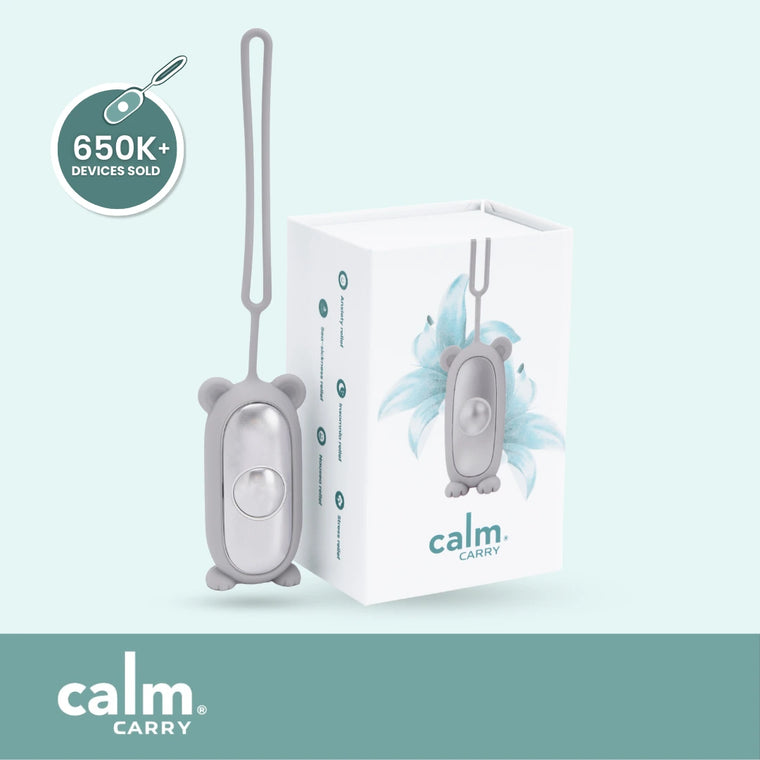
CalmCarry Kids is a small bear-eared device that sits in the palm. It gives a soft pulse, like a tiny heartbeat, against the PC8 point, also called Lao Gong, in the centre of the palm. It uses a very low microcurrent, felt as a soft pulse rather than a vibration, and PC8 is a point used in acupressure tradition for over a thousand years. That is how we describe it and as far as we will go. It is recommended by therapists, more than 650,000 families keep one, and families rate us 4.9 out of 5. Our explainer on the PC8 point in the palm sets out the tradition, and our honest look at the evidence covers what the research does and does not show.
If you would rather start with something free, our round-up of seven calming tools parents actually use puts the no-cost options first, and most of them belong in step six just as well.
What this routine will not fix
- A bedtime that is genuinely too early. A child lying awake for an hour with nothing wrong may simply not be tired yet. Move lights-out later by 15 minutes and see, rather than adding more routine.
- Children under about three. Six steps is too many. Three steps, always the same, is the realistic version at that age.
- Households where bedtime moves by an hour or more. The sequence still helps. The times will not hold, and pretending otherwise just makes everyone feel like they are failing.
- Anything happening in the middle of the night. Night waking and early waking are separate problems with separate fixes, and a wind-down routine barely touches them.
- A child who is distressed most nights rather than unsettled. If bedtime is frightening rather than boring, or it has changed suddenly, that is a conversation with your GP or paediatrician, not another routine tweak.
Bedtime questions parents ask
How long should it take a child to settle at bedtime?
Fifteen to twenty minutes from lights-out is normal for most school-aged children. Under five minutes every night can mean bedtime is a little late; consistently over 45 minutes usually means the wind-down is too short, too bright, or too variable.
How do I help a child settle at bedtime without me in the room?
Shorten your presence rather than removing it. Sit on the bed for a few nights, then the chair, then the doorway, then the landing, moving on only once the current spot is easy. Keep the same one-line reply throughout so nothing else changes at the same time.
Should I let my child have a light on?
Yes, if it helps, as long as it is warm and dim rather than bright and white. A low lamp or a plug-in nightlight is fine. A tablet used as a light is not, because it comes with everything else on the tablet.
What if my child gets out of bed?
Walk them back with as little talk as possible, every time, using the same line. The first three nights are usually worse than before you started, because the old pattern is being tested. Two weeks is a fair trial.
Does what they eat or drink in the evening matter?
Enough to be worth tidying up. Keep chocolate, cola and energy drinks out of the evening, and offer water rather than a large drink right at bedtime so the toilet does not become the eighth step. If you are weighing up supplements, our guide to melatonin alternatives for kids covers what is actually in them.
Start tonight with the two steps that cost nothing: lamps instead of ceiling lights an hour before bed, and screens out of the bedroom at the 45-minute mark. Run the same six steps in the same order for two weeks before you judge it. If your child would settle better with something to hold in step six, this is the one we make.